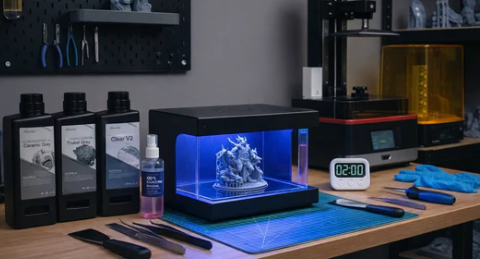
If you are choosing between a 3d resin printer and filament printing for cosplay props, you are really choosing what kind of problems you want to solve first. People also ask for the best resin 3d printer because they want clean detail without constant tuning.
In practice, most makers end up using both. The fastest path to a wearable prop is usually a smart split between big structural prints and small high detail parts, plus a finishing plan that matches your time and workspace.
What Cosplay Props Demand
Before you compare machines, define success in terms of fit, finish, and reliability. Looking at a focused 3d resin printer category can help you frame the resin side of that workflow without getting lost in random spec sheet debates.
Scale And Seams
Large props force compromises. A helmet or chest piece often needs part splitting, alignment keys, and seam hiding, so your printer choice should support predictable dimensional fit. Filament is usually forgiving for big shells, while resin shines when parts are smaller and need tight detail.
Paint Readiness
Paint reveals everything. If your design relies on shallow textures, fine bevels, or crisp engraved lines, a 3d resin printer can preserve those features with less surface correction before primer. For filament parts, expect more filling and sanding to avoid visible layer texture under gloss or metallic finishes.
Wear And Tear
Cosplay props get bumped, squeezed, and overheated. Filament parts often tolerate flex and impact better for wearable structures, especially handles, brackets, and internal frames. Resin parts are excellent for detail and surface fidelity, but large thin sections can be more vulnerable if stressed.
How Resin And Filament Really Differ
When people argue about the best resin 3d printer, they are usually asking for repeatable output and fewer failed prints, not just sharper photos online. The core difference is process, and process determines cleanup, safety, and finishing time.
How Resin Printing Builds Detail
Resin printing cures liquid photopolymer with light, building parts layer by layer, which is why surfaces can come out very smooth and edges can stay sharp. That advantage is widely noted in resin versus FDM overviews, including a neutral comparison from Ultimaker.
How Filament Printing Builds Volume
Filament printing extrudes melted thermoplastic, which makes it efficient for large forms and functional geometry. For cosplay, that often means faster fit checks for armor and props that need strength, while the visible surfaces may require more finishing work to look like real materials.
A Practical Pick For Common Prop Types
Think in parts, not printer brands. Decide which pieces must be lightweight and strong, and which pieces must look sharp at arm’s length. This keeps your build moving even when you are iterating designs the week before an event.
| Prop Need | Resin Tends To Favor | Filament Tends To Favor |
| Fine textures and small text | Yes | No |
| Large wearable shells | No | Yes |
| Low sanding before paint | Yes | No |
| Structural cores and handles | Sometimes | Yes |
Big Wearables
For helmets, armor plates, and oversized weapons, filament printing is often the backbone because it handles volume and rough handling well. You can still add resin details later, but your main goal here is clean seams and stable fit across multiple prints and reprints.
Detail Parts That Sell The Illusion
For emblems, greebles, face plates, and surface panels, a 3d resin printer is often the simplest way to keep edges crisp after primer. Many makers define the best resin 3d printer as the setup that stays consistent across batches, so the same part printed twice looks the same after paint.
Finishing And Safety Time Costs
Finishing is where cosplay schedules collapse. Plan your pipeline so sanding happens on large flat areas, and reserve resin for the details that would be painful to rebuild with filler. The best resin 3d printer outcome still depends on careful handling of uncured resin and disciplined surface prep.
Resin also demands workspace control. Basic guidance for additive manufacturing emphasizes reducing skin contact and managing ventilation for emissions and chemicals, which applies directly to resin handling and cleanup.
Conclusion
Filament is usually the best foundation for large wearable props, while resin is the best path to sharp detail and smooth surfaces. If you can split your build, a 3d resin printer plus a well chosen filament setup often beats chasing a single best resin 3d printer for everything.