In the rapidly evolving landscape of digital creation, the boundary between human ingenuity and machine efficiency is dissolving. Today, creators are no longer forced to choose between the soul of a manual project and the speed of an automated one. Instead, a new generation of sophisticated platforms is empowering professionals to scale their output without sacrificing their unique artistic vision. From high-fidelity video production to intricate graphic design, these solutions handle the heavy lifting of repetitive tasks while leaving the conceptual breakthroughs to the user.
1. Invideo: Redefining the Video Production Pipeline
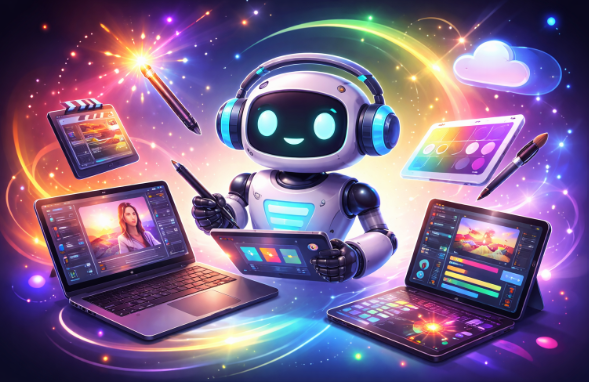
Invideo stands at the forefront of this revolution, offering a comprehensive suite that caters to both seasoned editors and marketing teams. The platform has recently integrated advanced generative models like Sora and Veo, allowing users to generate high-definition scenes that feel cinematically composed rather than procedurally generated. By utilizing a robust script to video ai workflow, the platform can interpret complex narrative prompts, select appropriate stock footage from a library of millions, and synchronize voiceovers in dozens of languages—all within a single, unified interface. This deep integration of automation ensures that the technical barriers to entry are virtually non-existent, enabling a “prompt-to-publish” speed that was previously unthinkable.
Beyond its browser-based capabilities, the service has expanded its ecosystem to ensure that creativity isn’t tethered to a desk. The dedicated video creator app provides a mobile-first environment where users can edit on the fly, apply AI-driven “twins” or avatars for testimonial-style content, and export in 4K resolution directly to social platforms.This mobile extension is particularly effective for creators who need to maintain a consistent brand voice across multiple channels while traveling. Whether you are building an ultra-realistic product demo or a long-form YouTube documentary, the tool’s ability to balance sophisticated automation with granular manual control makes it an essential asset for modern digital storytelling.
2. Adobe Firefly: The Intelligence Behind Visual Design
Adobe has long been the gold standard for creative software, and its AI engine, Firefly, brings that legacy into the era of automation. Unlike many standalone generators, Firefly is designed to be commercially safe, trained on a curated dataset that respects intellectual property. This makes it a go-to for enterprise teams who need to generate high-quality imagery for global campaigns.
The real magic of Firefly lies in its “Generative Fill” and “Text to Vector” capabilities. Instead of spending hours masking objects or manually drawing complex icons, designers can simply describe the change they want to see. Firefly automates the lighting, shadows, and perspective matching, ensuring that the new elements blend perfectly with the original composition. This seamless blend of AI and traditional design tools allows creators to focus on the “what” and the “why” of their project, rather than the tedious “how.”
3. ElevenLabs: The Future of Auditory Branding
Sound is often the most overlooked element of content creation, yet it is vital for emotional resonance. ElevenLabs has mastered the art of “Creative Audio Automation” by offering the most realistic voice synthesis available today. The tool uses deep learning to capture the nuances of human speech—the slight breaths, the emotional inflections, and the specific pacing that makes a voice sound authentic.
For businesses, this means the ability to automate the production of audiobooks, podcasts, and video narrations with a single click. You can clone your own voice or choose from a diverse library of professional-grade narrators. The tool even supports speech-to-speech translation, allowing you to take a recording in one language and automatically output it in another while keeping the original speaker’s unique tone and emotion intact.
4. Runway: Bringing Cinematic Effects to the Masses
Runway is a powerhouse for those pushing the boundaries of moving images. It offers a suite of “AI Magic Tools” that automate some of the most difficult tasks in filmmaking, such as rotoscoping, motion tracking, and background removal. What used to take a team of VFX artists weeks to accomplish can now be done in minutes through Runway’s cloud-based processing.
Their latest models allow for “Gen-3 Alpha” video generation, which creates hyper-realistic clips from simple text or image prompts. The tool’s “Director Mode” gives users precise control over camera movement—zooms, pans, and tilts—effectively turning the user into a virtual cinematographer. By automating the technical physics of light and motion, Runway provides a playground where imagination is the only limiting factor.
5. Canva AI Studio: Democratizing High-End Graphics
Canva has transformed from a simple drag-and-drop editor into a full-scale AI design studio. Its “Magic Studio” features are built for teams that need to produce high volumes of content without a dedicated design department. The “Magic Switch” tool, for instance, can take a single presentation and automatically reformat it into a blog post, a series of social media graphics, or even a professional email header.
The automation doesn’t stop at resizing. Canva’s AI can generate custom templates based on a brand’s specific color palette and logo, ensuring that every piece of content is on-brand. For the creative user, it provides “Magic Media” to generate unique photos and videos from text, and “Magic Morph” to apply complex textures and effects to simple shapes. It is the ultimate tool for blending high-level strategy with automated execution.
Conclusion
The tools mentioned above represent a fundamental shift in how we approach the creative process. By delegating the mechanical and repetitive aspects of production to AI, creators are gaining the freedom to experiment more boldly and produce more frequently. Whether it is a marketing team using a video creator app to stay relevant in a fast-paced market or a solo filmmaker utilizing a script to video ai engine to bring a vision to life, the result is the same: higher quality output with less friction. As these technologies continue to mature, the focus will stay exactly where it should be—on the human ideas that drive the machines.